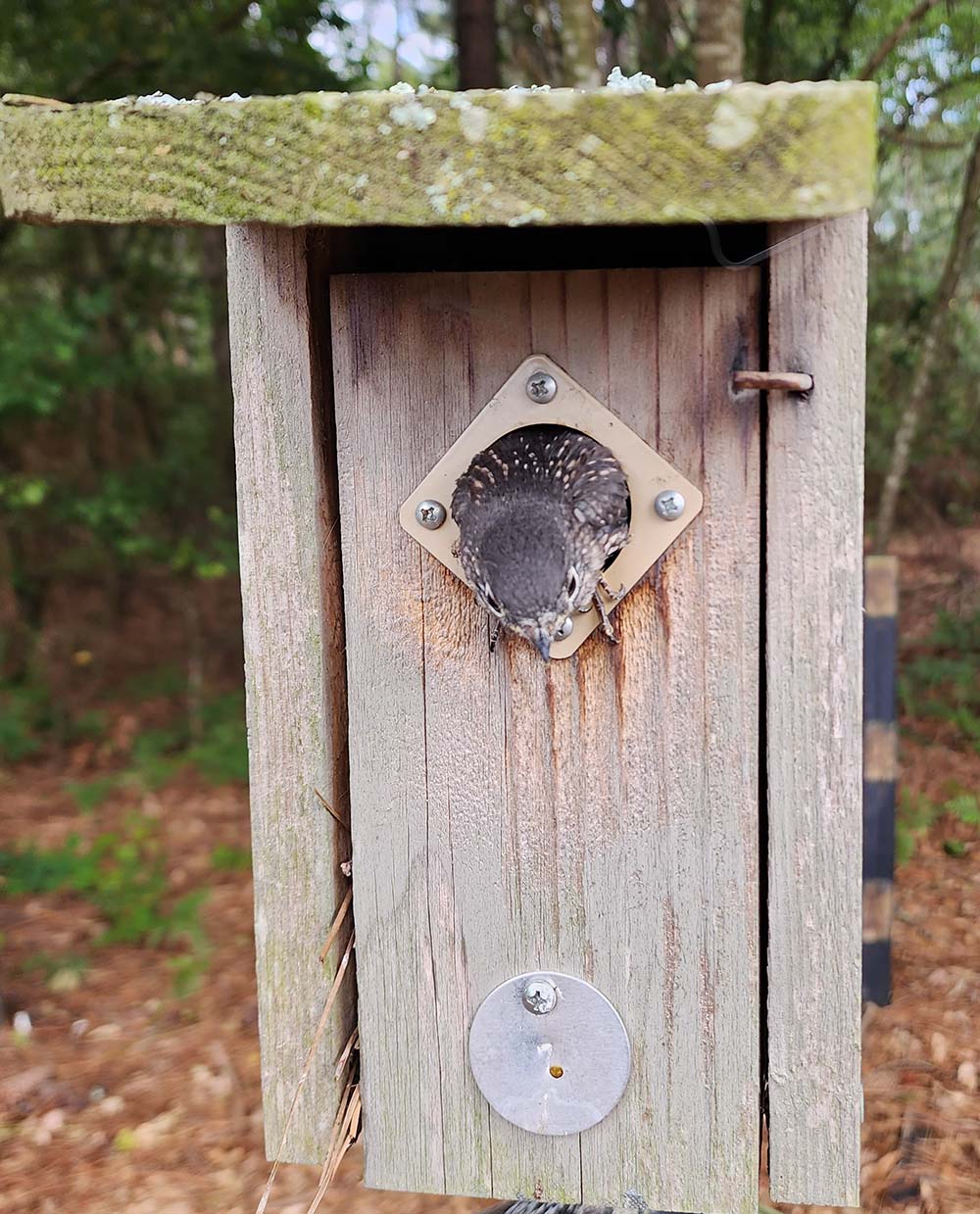
The Bluebird’s need for an artificial home (Nestbox) will never decrease as their natural habit is continuously under attack due to development. With that in mind, you will want to invest in a quality Nestbox Set that will withstand the elements over time.
A Nestbox Set consists of three separate pieces …. a Nestbox, mounting pole, and predator baffle. SCBS does sell the components separately, but we strongly encourage buying and installing the easy-to-install, high-quality Nestbox set. Our Nestboxes meet North American Bluebird Society (NABS) recommendations. If you do decide to buy a Nestbox set from someone else, make sure it has all the components listed below.
SCBS Nestbox Components:
One-inch Cedar or Cypress Wood
Cedar and Cypress woods have proven to be the best building materials. Many manufacturers use one-half inch wood materials which weather poorly, and can’t be solidly screwed together.
Rough Interior Surfaces
When the nestlings fledge, they climb up the inside of the Nestbox to the entry portal or hole. Smooth sanded wood, recycled plastic composites, or metal surfaces do not allow their talons sufficient grip to reach the opening. Thus, they may never fledge, and starve to death in the box.
Smooth Exterior Surfaces
Smooth exteriors are not only aesthetically pleasing, but also prevents splinters when handling the Nestbox.
Components are Screwed Together
Glue or staples are commonly used, but typically are not strong enough to hold the pieces of the box together for long periods of time. Remember this is a marathon, not a sprint, and you want these boxes to have a long-life span.
Slanted Roof
Flat roofs allow water to stand which causes accelerated decaying of the roof and unwanted moisture inside the Nestbox. Slanted roofs provide for runoff.
Roof Overhang
Roof should overhang the front (door) to sufficiently prevent rain from entering the Nestbox through the portal.
Roof Overlaps Back Panel
Roof should overlap the back panel. Many manufactures have the top panel butt into the back panel. However, in time the wood shrinks and a gap will open up between the top and back plate allowing water to enter the Nestbox.
Ventilation Holes
3 one-half inch holes on the upper part of both side panels and a gap at the top of the front door allow interior heat to dissipate. Again, this is very important due to our persistent sun during the nesting season.
Floor Drain Holes
If water enters the box the nest will be compromised, creating unhealthy mold, and the decay of the box will accelerate. Holes in each back corner of the Nestbox floor allow for drainage.
One and One-Half Inch Opening
This size portal / hole will restrict most non-cavity dwellers from entering the Nestbox. This includes the Starling, and other “nest stealing” species.
Metal Ring Door Hole Protector
This deters other animals, such as Squirrels, from chewing and enlarging the opening so they can use the Nestbox.
Bottom Hinged Door
This provides easy access for safe monitoring, allowing you to open just enough to initially observe the nest. This also prevents any chicks from possibly tumbling out of the Nestbox. With a top hinge you must raise the door completely to see inside. This can be dangerous for the chicks.
Perch or “Front Porch”
Bluebirds do not require a Nestbox with either of these appendages. These allow non-cavity dwellers perching access into the box.
Predator Baffle
Cone or stove pipe baffles are most common. We always recommend using a baffle to deter predators.
Mounting Pole
There are a variety of poles. Some can be difficult to install, and a challenge to securely attach the Nestbox and baffle. We highly recommend the ERVA solid steel 2-piece poles for simplicity of transport, installation, and attachment of the Nestbox and baffle. In addition, after installation the Nestbox is at eye level for ease of viewing and nest removal.
What goes into supplying the superior South Carolina Bluebird Society (SCBS) Nestbox?
There are five main costs incurred in producing a product. These costs are materials, production, sales, distribution, and profit. We are a non-profit 501 c (3) and our volunteers build, sell, and distribute our product. We incur no labor costs and sales revenue is used to fund our educational and scholarship programs.