
- Bluebird Biology & Conservation
- Nestbox Management
- Creating a Bluebird Habitat
Understanding Bluebirds
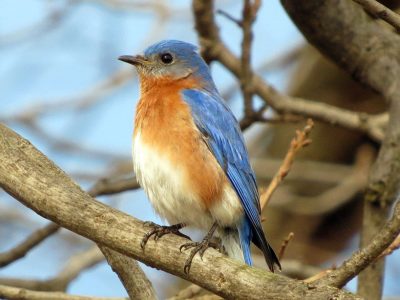
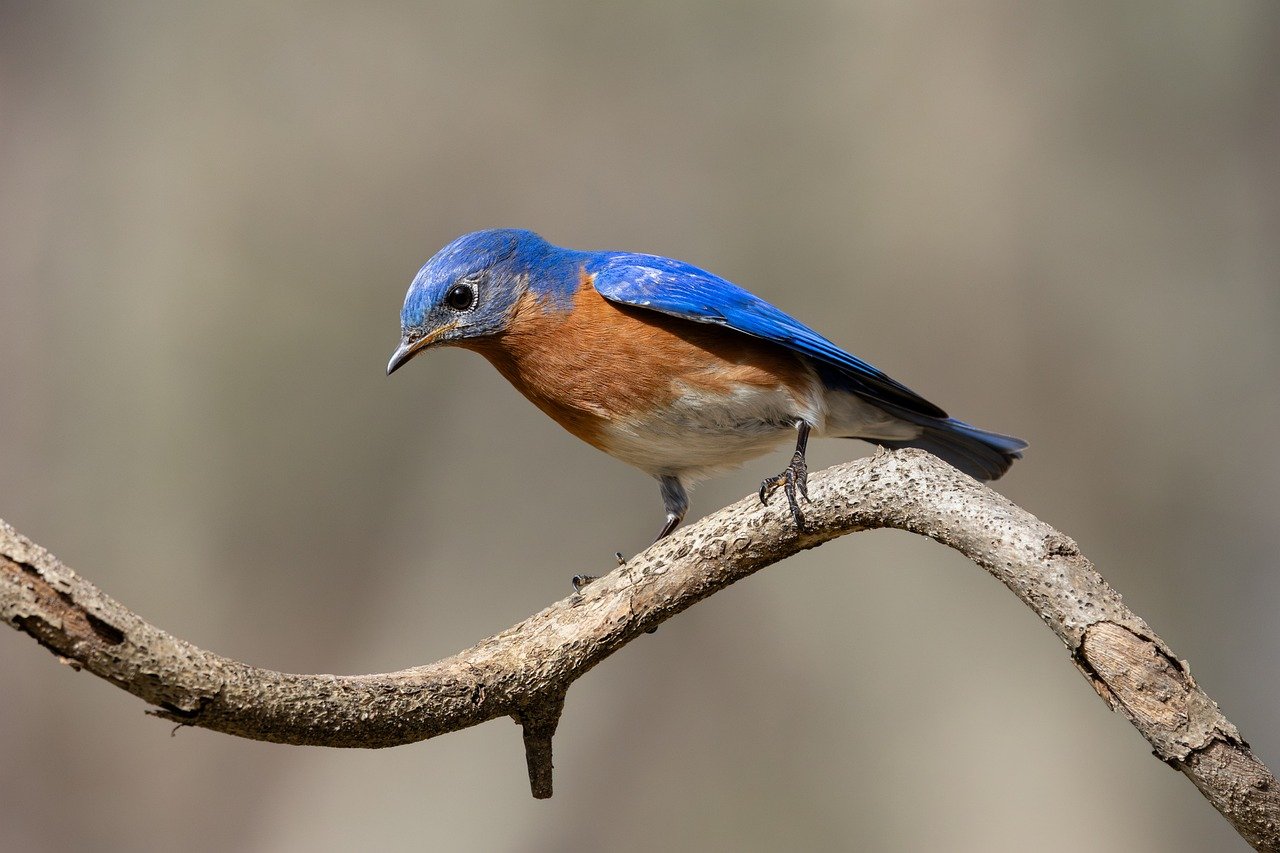
The brilliant blue male Bluebird has a rusty throat, breast and sides, and white belly. He sits high atop a dead tree or branch, TV antenna, or power line to hunt for insects that make up two-thirds of his diet…
He and his mate also eat wild berries, especially in cold weather when insects are not available. They rarely damage cultivated crops and are very beneficial to farmers and gardeners by eating insects. The young bluebirds have spotted breasts until fall molt.
As early as the end of February and as late as July, the male Bluebird locates a nesting site, establishes territory around it of two to five acres, and sings to attract a female and to warn other male Bluebirds to stay away. Once a female accepts the site, she builds a neat cup-shaped nest of dry grasses or pine needles. Nest building may take five days to three weeks.
The female lays one blue, or somewhat rare, a white (approximately 5%) egg each morning until three to six eggs are produced. The female begins incubating the eggs after the final egg is laid. Thirteen to fourteen days later, all viable eggs will normally hatch with hours of each other.
The adults begin feeding the young immediately after hatching, starting with soft insects and graduating to courser food as the nestlings grow. The adults also keep the nest clean by removing the fecal sacs that enclose the nestlings’ waste. The nestlings grow very rapidly, with their eyes opening on about the eighth day. By the time the nestlings fledge (leave) the nestbox, 16 to 20 days after hatching, they will be nearly the size of an adult Bluebird.
Usually, the entire brood of fledglings leaves the box within two hours. The fledglings can fly fifty to one hundred feet on their first flight and try to land in a bush, shrub, or low branch to avoid predators. The adults continue to care for the young and teach them to forage for food. The male Bluebird will continue this job while the female begins her second or third nest. On occasion, the young from a first nesting will help feed the nestlings from their parents’ second or third nesting.
After nesting season is over, Bluebirds give up their territories and flock together. South Carolina Bluebirds do not migrate. They are joined by migrant northern Bluebirds and roam the area looking for berries. In winter, Bluebirds will roost in pine tree stands and nestboxes to avoid cold weather.
Why They Need Your Help
Between the 1920s and the 1970s, the Bluebird population declined by an estimated 90%. There are several reasons for this, but the main reasons are loss of habitat and competition from other species…
Loss of Habitat
The Bluebird is a cavity-nesting bird, which means it prefers to build its nest in a tree cavity. Unlike the woodpecker, however, the Bluebird’s beak is not suited for excavating. It depends on natural cavities or ones made by other birds. However, the expansion of large commercial or agricultural operations, the growth of cities, and dense residential land development have destroyed many of the Bluebirds’ natural nesting places.
Competition
The main source of competition for Bluebirds is a bird that is not native to North America – the House or English Sparrow. The House Sparrow was introduced to this country in the mid-1800s. It was thought that this bird would help control insect pests; however, those that brought them here seriously underestimated this bird’s fiercely competitive nature. The House Sparrow population exploded, while that of the Bluebird dropped precipitously declined. While House Sparrows will nest about anywhere, they can find a nook or cranny, they compete with the more finicky Bluebird, and will often drive away adult Bluebirds, leaving the nestlings to starve to death. Worse, they will also peck open unhatched Bluebird eggs and kill the babies, or even adults they happen to find sitting in the nest. They have even been known to build their own nests on top of the bodies of the Bluebirds they have killed. Another source of competition for the Bluebird is the Eastern Starling, a bird that is equally aggressive and will also kill both Bluebird adults and young.
What You Can Do
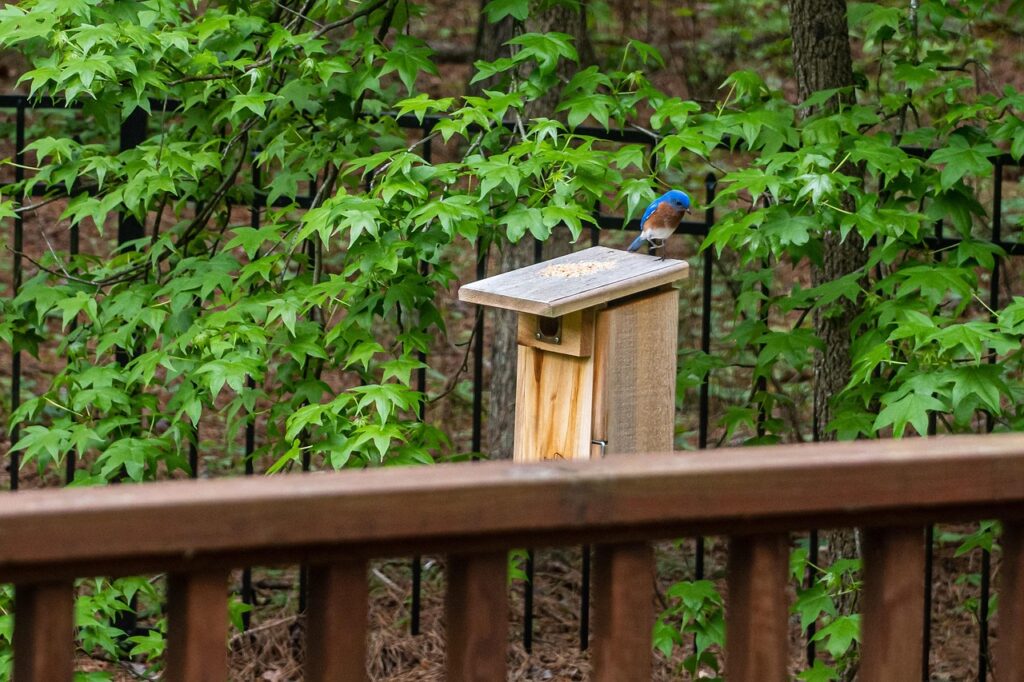
Installing a Bluebird Nestbox setup is the most important thing you can do to preserve and sustain the Bluebirds. Real Bluebird conservation takes a bit of effort, but it is well worth it.
There are several things to keep in mind when you decide to put up a Nestbox for Bluebirds:
Suitable Location
Bluebirds prefer to nest in an area that includes open space, scattered trees, and low ground cover such as lawns, golf courses, pastureland, parks, and school & industrial campuses. They do not nest in heavily forested areas. They also do not like land that is completely open (no trees or shrubs), but one that still provides perches for hunting (such as fences, telephone lines, posts, shepherd’s hooks, etc.) and trees nearby for both shade and to offer the baby birds a safe destination for fledging. Care should be taken not to place the nestbox so close to trees and fences, which predators are afforded easy access to the box from above. Keep boxes at least 200 yards from barnyards and feed lots where House Sparrows are abundant. Avoid areas with heavy pesticide use. Bluebirds are territorial, so as a rough guide, multiple boxes should be placed at least 100 feet apart. Vegetation and topography might make closer locations possible. There should be no direct line of sight between boxes. The nestbox can face in any direction as long as the Bluebirds have a clear flight path to the box.
Proper Nestbox
Birdhouses are readily available, but not everything called a “Bluebird house” is suitable for them. Purchase or build an SCBS-approved nestbox designed specifically for Bluebirds. Preferably, these are made of unpainted cedar, redwood, cypress, or pine. If you must paint your nestbox, it should be painted ONLY on the outside, in a very light color, to avoid overheating. The box should have an overhanging slanted roof, NO perch, and a round entrance hole 1-1/2″ in diameter. It should have ventilation and drainage holes, be deep enough so predators can’t reach inside to retrieve the eggs, and have a door that opens for ease of monitoring and cleaning.
We build SCBS-approved nestboxes and then sell the box, pole, and baffle (nestbox setup) at a discounted price to members. These high-quality items should last for a decade or more and the proceeds help fund our efforts.
Proper Mounting
Nestboxes may be mounted at any time, but to attract Bluebirds for their first nesting of the season, they should be in place by mid-February.
SCBS HIGHLY RECOMMENDS mounting nestboxes on a metal or plastic pole with a baffle to deter predators such as snakes, raccoons, squirrels, and feral cats. The nestbox should be mounted on the pole so that the entrance hole is approximately 5’ off the ground.
Monitoring Nestboxes
Being a conscientious Bluebird landlord involves more than simply buying or making a nestbox and mounting in a good location…
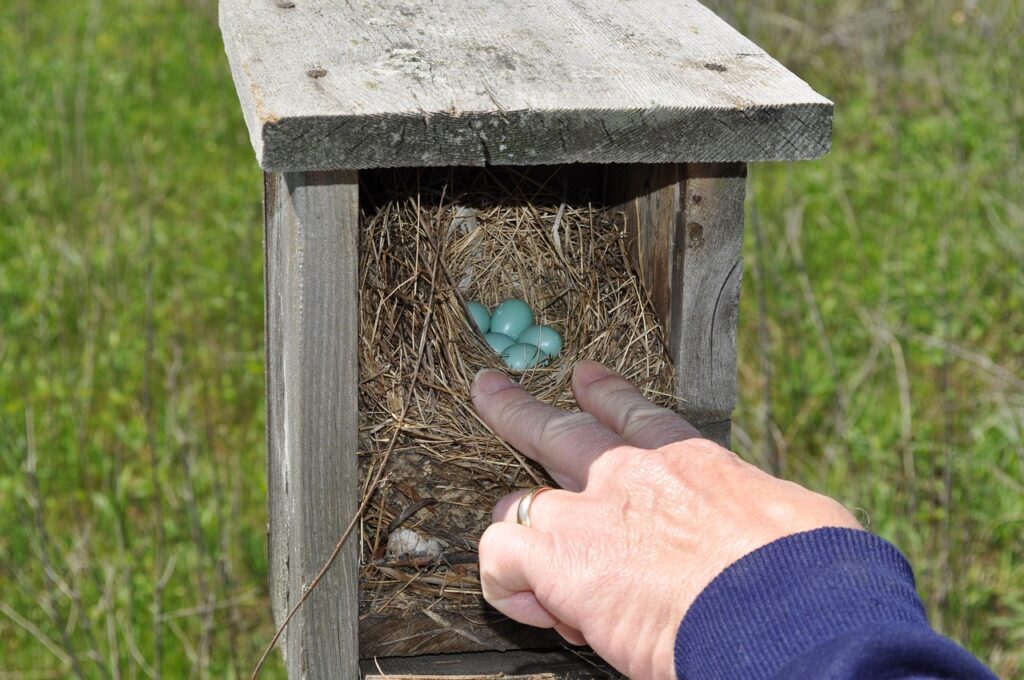
Monitoring your nestbox means that you open the nestbox on a regular basis to inspect the box and its contents. In doing so, you can determine the type of bird occupying the nestbox based on nesting materials (See Nest Identification under the Resources Tab). You can take note of the number of eggs and/or young that have hatched. You can also identify the relative age of the young by knowing when the eggs were laid and hatched. (See Eastern Bluebird Nestling Growth Chart under the Resources Tab).
Photo by Mike DeBruhl
Nestboxes should be monitored at least once a week for pests and predators. (See Pests and Predators under the Bluebird Facts Tab) Bluebirds readily tolerate humans monitoring their nestboxes. They will not abandon their young because humans have looked at or touched them. Bluebirds do not have a good sense of smell, so your scent on their nest will not disturb them.
Care should always be taken when opening a nestbox, especially once the hatchlings are 12 days old, as this could cause them to fledge too early. The nestbox should be cleaned out after each brood of babies has fledged. Bluebirds will not reuse a nest. If the old nest is not cleaned out, they will build a new nest on top of the old one which places the new nestlings dangerously close to the entrance hole.
Bluebirds will typically produce two or three broods from March to August in South Carolina. A typical brood is 3-5 eggs.
If you want to formally monitor your box, which is STRICTLY OPTIONAL, download the Trail Monitoring Form (under Resources Tab) and record your observations weekly starting with the nest building activity. When fledging occurs, you can go to Resources/Trail Reporting Form found under the Resources Tab. Follow the instructions, fill in the required data, and press the Submit button. The data is collated by SCBS and posted on this web site under Resources/Trail Statistics.
The data gathered from trail monitoring is also sent to Cornell Lab of Ornithology. This data allows organizations such as NABS to identify problems within
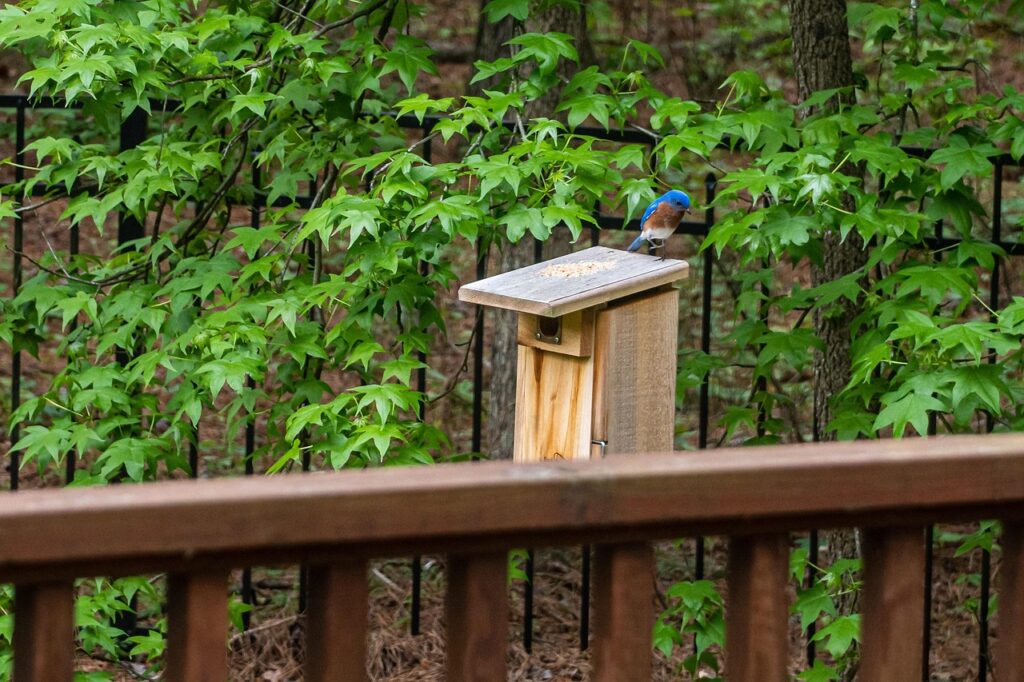
Nest Removal
Part of being a responsible Bluebirder is removing the nesting material from the nestbox. There are two main reasons for taking this action…
There are two main reasons for taking this action. The first is that Bluebirds do NOT reuse a nest but instead will often build a new nest on top of the old one. This will quickly lead to the nestbox becoming unusable because of excess nest debris and bird excrement. The second reason is that with the addition of another nest, the height of the nest places the eggs and new hatchlings dangerously close to the entrance hole. This allows predators to reach inside and remove the eggs/hatchlings.
Listed below are four typical scenarios that necessitate nest removal. Two of them require “rigid” monitoring to keep track of dates. Simply pick a day of the week that you will consistently check your box and record your findings (nest/number of eggs or hatchlings) each time for future use. You can print and use our Trail Monitoring Form. Recording the dates at each visit will help you feel confident about the 3-week time period in scenarios 1 and 2 below. You can monitor more frequently but monitor and record your status, at minimum, weekly. If you go to remove the nest and find that a new nest has already been started just leave the previous nest in the nestbox. Otherwise, follow the steps below depending on the circumstances:
- If it has been 3 weeks since your nest was completed but no eggs have been laid- Remove the nest, place it in the trash (not on the ground), remove the debris from the nestbox, and spread a teaspoon of Diatomaceous Earth (DE) on the floor of the nestbox.
- If it has been 3 weeks since the entire clutch of eggs has been laid but none have hatched- remove the nest and eggs, place them in the trash (not on the ground), remove the debris from the nestbox, and spread a teaspoon of Diatomaceous Earth (DE) on the floor of the nestbox.
- If your eggs or immature hatchlings disappear due to predation- Remove the nest, place it in the trash (not on the ground), remove the debris from the nestbox, and spread a teaspoon of Diatomaceous Earth (DE) on the floor of the nestbox.
- If your hatchlings mature in 16-21 days and fledge- Remove the nest, place it in the trash, remove the debris from the nestbox, and spread a teaspoon of Diatomaceous Earth (DE) on the floor of the nestbox.
Feeding Bluebirds
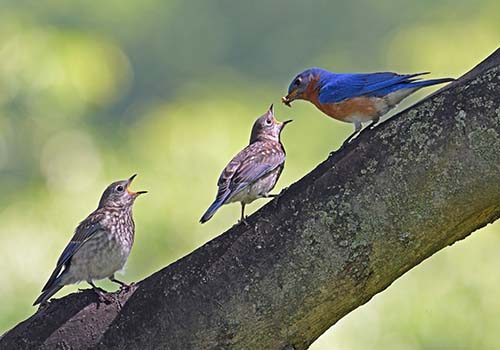
It is not normally necessary to feed Bluebirds; however, many people find they enjoy offering treats to their birds,…
both to help them through times of difficulty, and to have the opportunity to interact more closely with these gentle, trusting creatures. They eat insects, insect larvae, and berries. Some common native berry bushes that bluebirds enjoy are Flowering Dogwood, Holly, Juniper, Sumac, Mountain-ash, Mistletoe, Hackberry, and Firethorn. (See Bluebird facts Tab and Native Plants subtab for a complete list of plants.) Another food commonly offered to Bluebirds is mealworms. They are available as live or dried. The dried are significantly cheaper and easier to store and use. If you use live worms, you will not be able to buy enough as the Bluebirds voraciously consume them. They can be purchased in bulk from several mail-order houses, or obtained locally at bait shops and wild bird supply stores. During the winter months, Bluebirds will come to suet feeders and seed feeders containing sunflower meats. One caution is if you like to feed other species of birds – do not place your Bluebird nestboxes too close to your wild bird feeding area. Feeding seed “blends” containing corn, milo, and millet, or feeding stale bread, rolls, or donuts will attract house sparrows to your yard, and endanger your Bluebirds. Bluebirds also enjoy shallow birdbaths, especially those with a drip/misting feature.
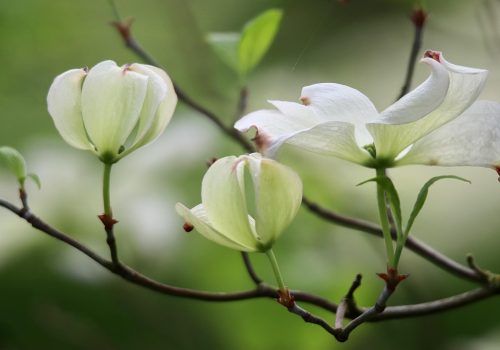
Native Plants
For ease of identification and clear communication with landscape nursery professionals, this list has been…
organized according to alfa-scientific nomenclature. The use of confusing or colloquial plant names or nicknames has been avoided. Plants that are toxic, aggressively invasive, non-native, parasitic or USDA Exotic Plant Control listed are not recommended.
For a thorough description of a plant and its cultivars it is recommended that you consult an authority such as Manual of Woody Landscape Plants (ISBN 9780875638003) by Michael A. Dirr at your library or nursery before purchase of plant material. If possible, select and purchase your plants by scientific name only.
Pests and Predators
Since Bluebirds live in the wild and there are lots of predators you can minimize the risks by following the precautions listed below…
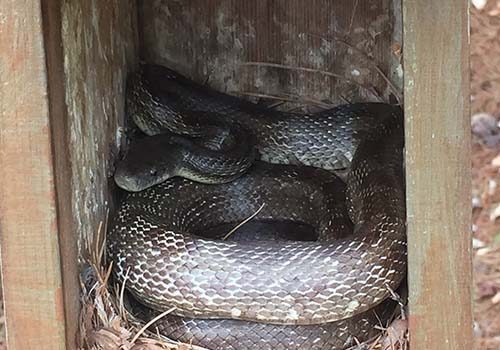
Snakes: The black rat snake is the main predator in South Carolina but Corn and Black snakes also participate. Of our predators, the rat snake is the most common, usually responsible for more than 80% of our predator losses. In our experience of monitoring thousands of Nestboxes, we have not found a venomous snake in a Nestbox in South Carolina.
Ants: Fire ants are common in South Carolina and will attack baby Bluebirds.
Frequency is low. To avoid this problem carefully examine the ground around your box in a 20-foot circle for holes in the dirt and especially half-moon piles of sand each time you monitor the box. If you see any ant activity treat it with an Ant killer such as Amdro. You can also apply bearing/axle grease to a 6-inch section of the pole, preferably under the predator guard.
Crows: These incredibly intelligent birds have been known to stand on the top of the box and reach down thru the opening to remove the young.
Frequency is low. Some Bluebirds build very tall nests which allow the crow to rob the nest if the young are near the entrance hole. As you monitor your Nestbox check to see if the top of the nest is very near the entrance hole. If so, gently remove the lower section of the nesting material to reduce the height of the nest and leave 3-4 inches of nest material.
Feral Cats: Feral cats may be a problem for birds if a predator shield is not installed on a Nestbox.
Frequency is low. You can prevent this problem by installing a predator shield on your metal pole and ensuring the box is not within 10 feet of a fence/tree.
Flying Squirrels: They are more of a nuisance than a predator as they do not usually kill the babies but instead take over the box for their own brood.
Frequency depends on the population of flying squirrels in the area. If they are in the area, the frequency can be high.
Flying squirrels are known to glide for 50 feet. By moving your box at least 30 feet from the closest tree branch most problems can be avoided. If the problem persists submit a Volunteer/Contact form and one of our board members will respond.
Gray Squirrels: They are more of a nuisance than a predator as they do not actively hunt the baby birds but instead take over the box for their own nest. Gray squirrels are normally too big to enter a Bluebird nestbox with a 1.5-inch diameter hole. The squirrel may chew the entrance hole to open it wider to allow entrance into the nestbox.
Frequency depends on the population of squirrels in the area. If they are in the area, the frequency may be high. This is easily prevented by moving the box 10 feet from any tree branches and installing a predator shield on your metal pole. In addition, place a metal guard around the entrance to prevent a squirrel from chewing on the wood around the hole.
Hawks: Cooper’s and Sharp-shinned hawks in addition to Kestrels attack and kill birds.
Frequency-moderate. There is nothing you can do to prevent this from occurring.
House Sparrows, English: They are non-native and considered to be an invasive species. They are known to kill the mother/babies in the box and break the eggs. If you open the box and find blue feathers and broken eggs, they are the most likely suspect.
Frequency is area dependent. See NABS Factsheet House Sparrows under Resources Tab for nest/egg identification and possible mitigating actions. These birds are non-native and are not federally protected. The nest and eggs can be discarded but it is preferable to apply a coating of oil to the eggs or shake the eggs and place them back in the nest. The mom will continue to incubate and not attack another nest but the eggs will not hatch.
Mites: Mites are introduced into the nestbox when the nest becomes dirty from fecal matter or spillage of food materials. They can cause irritation and feather loss.
Frequency is common. Apply a layer of diatomaceous earth (a white powdery substance commonly called DE) on the floor of the nestbox prior to nesting or squirt some into the nesting materials using a plastic squeeze bottle. Clean out old nesting material usually laden with fecal matter from previous broods.
Raccoons: These critters are highly intelligent and strong. They can rip apart a nestbox and eat all moms/babies/eggs found. They normally reach into a nestbox and grab whatever they find including eggs and young or adult birds. If you find nesting material hanging out of the nestbox, you can be certain that the nest was robbed by a raccoon or cat.
Frequency is low. You can prevent this problem by installing a predator shield on your metal pole and ensuring the box is not within 5 feet of a fence/tree. You can also install a “Noel Nest Guard” around the entrance hole of the nestbox.
Frequency is high. There is no silver bullet to this problem but the most effective weapon is the predator shield and not throwing the old nest on the ground near the box. Snakes have incredible memories and may return. If a snake robs your nestbox, the nesting material will remain undisturbed.
Starlings: They can be an aggressive nestbox stealer.
Frequency is none if you use an SCBS-approved nestbox. They are prevented by restricting the hole in the nestbox to 1 ½ inches in diameter.
Wasps/Bees: When they take over the nestbox the Bluebirds will abandon the box and babies.
Frequency is common. When approaching the nestbox, stop 5 feet away, listen, and observe. They build nests up under the predator shield and/or inside the nestbox. Taking EXTREME caution, you can use one of the commercial wasp sprays that allow you to stand 10 feet away. If inside the box, shoot the spray thru the entry hole. Once the wasps/bees are dead, they can be removed. If you have an allergy to wasps or bees, make sure you carry the appropriate medicine with you.
Ticks: Ticks are introduced into the nestbox via the parents or from nesting materials. They can cause irritation and death of the young as they suck blood from the host.
Frequency is uncommon. Visually inspect the young before feathers develop to see if any are apparent. Apply a layer of diatomaceous earth (a white powdery substance commonly called DE) on the floor of the nestbox prior to nesting or squirt some into the nesting materials using a plastic ketchup squeeze bottle. If ticks are found, gently remove the young from the nest and remove/pull the tick from the youngster.